Published
December 31, 2025
Issue Description
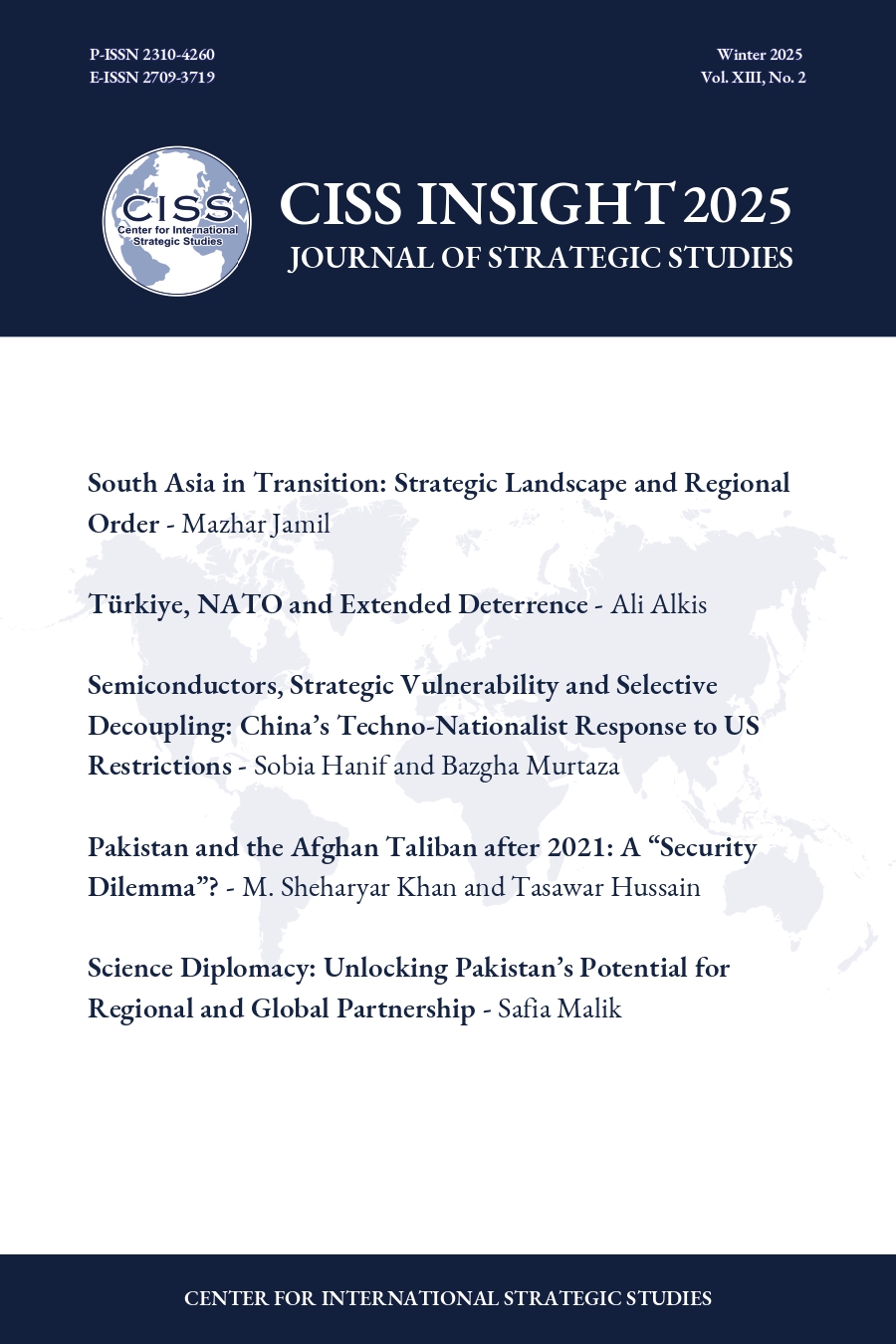
The latest issue of CISS Insight Journal engages a broad spectrum of contemporary strategic debates at the national, regional, and global levels. It features five scholarly research articles alongside critical reviews of three significant books. Together, the contributions examine evolving power configurations, technological competition, alliance politics, regional security dilemmas, and emerging avenues for diplomacy, with particular relevance to Pakistan’s strategic environment.
The first paper, ‘South Asia in Transition: Strategic Landscape and Regional Order,’ analyzes the shifting balance of power in South Asia against the backdrop of persistent India–Pakistan rivalry. It assesses how ideological transformation within India, particularly under the Bharatiya Janata Party (BJP), has altered the regional security calculus. By examining the interplay of hegemonic aspirations, revisionist narratives, and perceived conventional superiority, the paper evaluates their implications for regional peace and strategic stability. It further explores how Pakistan, as a responsible nuclear-weapon state, can pursue calibrated responses and avenues for mutual restraint to prevent escalation and preserve deterrence stability.
The second paper, ‘Türkiye, NATO and Extended Deterrence,’ examines Türkiye’s role within NATO’s nuclear-sharing architecture. It traces Ankara’s historical and contemporary engagement with the Alliance’s nuclear posture, including its hosting of U.S. tactical nuclear weapons and participation in exercises such as Steadfast Noon. The study evaluates operational, political, and technological dimensions of Türkiye’s contribution, including air force modernization challenges and exclusion from the F-35 program. It also highlights the tensions between Türkiye’s pursuit of strategic autonomy and its commitments to alliance cohesion and non-proliferation norms.
The third paper, ‘Semiconductors, Strategic Vulnerability, and Selective Decoupling: China’s Techno-Nationalist Response to US Restrictions,’ investigates the intensifying technological competition between the United States and China. Framing advanced semiconductors as strategic assets central to economic and military power, the study analyzes China’s drive for technological self-sufficiency amid export controls and supply chain restrictions. Employing a qualitative case study approach, the paper evaluates how techno-nationalism and selective decoupling are reshaping the global technopolitical order and generating new forms of strategic interdependence and rivalry.
The fourth paper, ‘Pakistan and the Afghan Taliban after 2021: A “Security Dilemma”?,’ explores the evolving and increasingly strained relationship between Pakistan and the Taliban-led government in Afghanistan. It argues that the relationship is characterized by a security dilemma between a sovereign state and a quasi-state authority, sustained by mistrust, divergent threat perceptions, and cross-border militancy. The study assesses how misperceptions and instrumental considerations—particularly regarding the Tehrik-e-Taliban Pakistan (TTP)—have complicated bilateral engagement, and outlines policy-relevant implications for Pakistan and regional stability.
The fifth paper, ‘Science Diplomacy: Unlocking Pakistan’s Potential for Regional and Global Partnership,’ examines science diplomacy as a foreign policy instrument for addressing non-traditional challenges and advancing sustainable development. Drawing on the framework of the United Nations Sustainable Development Goals (SDGs), the study evaluates Pakistan’s existing initiatives and identifies future areas for bilateral and multilateral scientific collaboration. It argues that targeted investments in research partnerships, technology sharing, and innovation ecosystems can enhance Pakistan’s developmental trajectory while strengthening its international standing.
In addition to these research articles, the issue presents reviews of three important books: Pakistan-India Relations: Fractured Past, Uncertain Future; Going Nuclear: How the Atom Will Save the World; and Weapons in Space: Technology, Politics, and the Rise and Fall of the Strategic Defense Initiative. These reviews critically engage debates on South Asian rivalry, the future of nuclear energy and deterrence, and the militarization of outer space, thereby complementing the thematic focus of this edition.